Showing posts with label art. Show all posts

Friday, September 21, 2018

Gold Rush

There were several gold rushes throughout history which drew droves of eager prospectors from all over to an area pregnant with the promise of wealth and prosperity to those lucky enough to find the golden nuggets nestled waiting within the earth's crust.

This image sprang to mind while reading that an Australian man recently uncovered a large amount of gold in the northern goldfields of western Australia worth up to $110,000.  I really hadn't realized that the dream of striking gold was still alive for some.  Then I really thought about it, where does gold even come from?

Recently discovered "Duckfoot"

For years I've written on the history of gemstones and jewelry and why they are so preciously expensive, but why is gold precious?

Gold is an element and lives on the periodic table as a transitional element with the atomic number of 79.  It is considered to be one of the least reactive chemical elements and is the most noble of all the noble metals, making it the most resistant to corrosion.

Gold is considered very rare since it is believed there is only a finite amount in the solar system that was present as dust the day it formed. So whatever we have on earth is what we get, it does not have a recipe to form like a gemstone does. It is an element created on a celestial level and cannot be reproduced.  Gold ore is found in solid form usually as a nugget, granular, or in veins, but also exists as flakes and dust.  Gold does not have a habit formation like a gemstone does further proving it is the most malleable of all the metals.  When found during mining, what is being found is gold that is by chance clumped together in a mine-able form, and sometimes this gold is naturally alloyed with other elements and is not pure. To get pure gold, it must be refined to extract impurities and other metals.


Gold in it's purest form is very soft and to be used for jewelry needs to be alloyed with another metal for strength and sometimes color.

The most familiar karats of gold are:

10K or .417 meaning 41.7% pure gold alloyed with other metals like silver, copper, zinc, and/or nickel.

14K or .585 meaning 58.5% pure gold alloyed with other metals.

18K or .750 meaning 75% pure gold alloyed with other metals.

24K  or 999.9 is considered fine gold at 99.95% pure gold.

10k is much harder and more durable than 18k or 24k but not as rich in color is the main difference between these karats besides gold content and price.

For example I chose 18k for my engagement ring because it's rich color to matched my yellow center, and I know I'd be gentle with my ring knowing that it will be more susceptible to scratches and nicks.  For someone hard on their jewelry I always recommend 10k or 14k.

Sunday, June 17, 2018

Admiring the Strength of the Elephant

One of my favorite animals is the elephant.  They're majestically massive and at the same time incredibly intuitive and nurturing.  They are complex creatures which explains why they are so prominent as a motif in several cultures.  Here I'm wearing some of my favorite LAGOS pieces while taking a look at the iconography of the elephant.


One of the most popular depictions of the elephant is through the Hindu religion.  The god Ganesha is easily identifiable with his large elephant head on a human body.  His likeness will be found across South Asia in countries like India, Nepal, and Thailand.  Ganesha is a patron of the arts and sciences and looked upon as the remover of obstacles.  A steadfast god to look to in times of trial.


In Buddhism you will find the presence of the elephant pair Kangiten, represented as male and female elephant headed humanoid figures embracing as a symbol of the unity of opposites.  Enforcing the belief of the oneness of all things though they may be seemingly different.


In Islam, the Quran has a chapter entitled "The Elephant".  A story of a Abraha's white elephant, Mahmud, that refused to cross into Mecca, foiling Abraha's plan to lead Yemen to conquer the holy city.  Mahmud could not be persuaded to cross by reason or violence, once again depicting the elephant as a creature of intelligence and resolve.

The elephant is not indigenous to Europe but was discovered through their exploration or Asia. Awed by the ferocity of the war elephant in battle, Europe adopted the beast as a symbol of militaristic strength. Napoleon even commissioned a giant cast bronze elephant fountain to be made from guns confiscated in victorious battle.  The fountain was never completed (hello Waterloo).


America adopted the elephant to represent the Republican party in 1884.  The origin is a political cartoon done by Thomas Nash.  The elephant is shown charging in dispersing other smaller animals representing other political interests at the time.  Another account of dominance and strength.


Lastly Elephants are native to Africa and usually where most people imagine them. In Africa the elephant is revered for its strength, wisdom, and memory. The elephant was depicted on several coat of arms throughout time in Africa including South Africa, The Ivory Coast, the kingdom of Laos, and the kingdom of Dahomey.


Globally you can see the elephant is respected and admired for it's strength, it is looked to for it's wisdom, and it is a symbol of conquering obstacles and embracing change.


Sunday, November 12, 2017

Van Cleef & Arpels' Noah's Ark Exhibition

Last weekend I had the pleasure of embarking on an enticing visual journey curated by Van Cleef & Arpels’ interpretation of Noah’s Ark as imagined by famed set designer Robert Wilson.  The Parisian designer is known for producing masterful pieces of high jewelry that set a scene for the wearer or admirer.  The whimsical figures are expertly produced allowing a person’s focus to shift from execution into intention.  What is the story being told through the piece’s movement and color?

To immerse the viewer into the story of Noah’s Ark, Wilson selected an art space in Chelsea New York City, which he transformed into a page out of a children’s story book.  As we walked into the space, I needed to lower my head as if I was garnering passage upon a vessel.  Once inside I was encapsulated into a serene bluish room whose walls rippled like waves due to projected lighting.  Suspended from the ceiling was a wireframe wooden model of an ark, gently suggesting we had set sea and the only place that existed anymore was what was in the room.  Within the room were shadow boxes set into the walls beckoning us to peep in on the jeweled creatures inside as if they were residing in a stall on the ship.


What was on view was breathtaking, each animal was coupled with a partner as dictated in the old bible story having them boarded “two by two”.  Some jewels were expected, such as colorful sapphires and garnets, but there were unexpected treats on view as well such as snowflake obsidian carved into the likeness of rabbits.


One of my favorite minerals is jasper and I was elated to see it carved into a majestic depiction of resting rams.


Viewers were only given about 20 minutes to view the room, while experiencing light and sound effects articulating heavy rainfall.  Needless to say 20 minutes was not enough time for me to take it all in, thankfully the staff was very kind and allowed my friend and I to cycle through again while treating us with a canvas bag containing a booklet explaining the event.


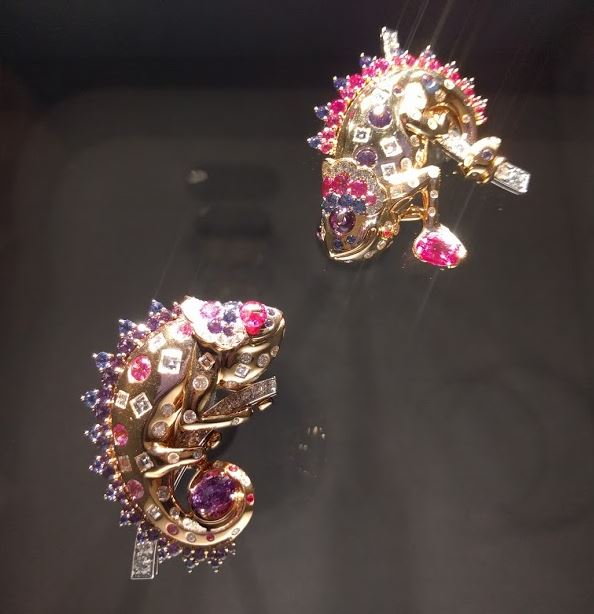
On the second viewing I noticed a little more intention in the way the room was set up.  Similar colors and figures were set parallel from each other across the room.   Such as the geometrically heavy in design giraffe was set directly across from the similarly colored and set chameleon.  


The more polar like animals were set to the back of the room, decadent in pearls.


In the center of the wall a large opal with lively play of color and creatures giving off the illusion of movement.


And the feeling of texture.


The exhibit is on display for another week, more information can be found on the site here.


In celebration of the world renowned exhibit the Van Cleef & Arpels store is also displaying the jeweled creatures, though the same in figure, much different and warmer in hue.

The whole experience was otherworldly, giving a sleepy dreamlike illustration of a familiar story.

Tuesday, October 24, 2017

Ladies Night Art Crawl

Fall is my favorite time of year for several reason;, scarves, foliage, spiced cider, but most of all craft fairs.

My pumpkin spice fiance and I decided to enjoy the newly crisp fall air by moseying through the Ladies Night Art Crawl.  The event consisted of a string of predominantly female owned studio spaces opening their doors to the public to come look, touch, and buy made in Philly art.

Scrawled below is the map distributed by the vendors, the starting point being The Common Room , a creative space to curate woman created art.


There I came across two new artists to follow.  The first being Sadie Francis of Only in the Forest.  Francis has worked in the environmental field for 15 years, in doing so she carried her hobby over to shareable wearable art.  The flowers she encases in resin are found during long daily walks through Philadelphia’s expansive park system. I’ve seen this type of jewelry before, so what really makes these pieces poignant is knowing they’re local and made by someone who deeply cares about sustaining nature.  They’re not just flowers, they’re flowers from our community.


The second artist I came across was MEO-C.28  who created an exciting take on the necklace bib. She paints exaggerated baubles onto re-purposed fabric to create the look of a bib without the heft of it.  Light weight and handcrafted, these works give new life to a tired trend.


Last but not least is always a favorite of mine, Forge and Finish.  A trio of Temple ladies working together to handcraft jeweled treasures.  My current favorite collection is Talo, jeweled with a tasty bluish green tourmaline.  Forge and Finish does an excellent job of echoing shape between collections allowing a wearer to mix and match between collections. Each piece is a work of art with a slight edge that sets it aside from it’s peers. Very wearable while still making a statement.


Monday, September 11, 2017

Acrylics in Fashion

Synthetic materials first appeared on the market for practical purposes, industrial purposes, and now for fashion purposes, trickling down into the realm of contemporary jewelry.  Clear acrylic plastics have taken the forefront of self expression by creating a sleek futuristic look.  

Harling Ross of Manrepeller harps on the needing to find a fall fashion identity, a refreshed styling to embrace the new season (ManRepeller).  The acrylics of Corey Moranis lend a helping hand of giving a structural presence without overbearing with color or overworked design (Corey Moranis).

Acrylic rods are heated and twisted into knotted shapes, taking a very utilitarian material, and forming it into a more nurturing organic shape.  The pieces are bold in size, but completely wearable in color and design.  Even the styling of the models on Moranis’ site aid to the new millenia feel of the pieces with their minimized makeup and slicked down hair.


The surge of synthetics in fashion is not a new concept, just becoming more mainstream. Instead of being reserved for high fashion or exhibition art, it now can be purchased and worn as streetwear. The Met in New York is showcasing this in it’s latest exhibition, The Secret Life of Textiles: Synthetic Materials on display until September 17th, 2017 (The Exhibit).

We’ll be seeing more and more synthetic materials in the accessory field as products like 3d printers and laser cutters become more available as household items allowing the everyday craft artist to discover and use the medium.  There is a fear that wearables will become cold, too computerized, and perfect, losing the human touch that makes jewelry so emotional.  However, a true craftsman will be able to overcome this feat as we see in Corey Moranis’ pieces. They are simple but have been very worked, creating value through the level of care and execution present.

It’s an exciting time in modern jewelry to have a chance to create a new chapter or wearables in our craft history.

Monday, February 27, 2017

Charlize Theron wearing "Garden of Kalahari"


Charlize Theron elevated her pleated gold Dior dress with showstopping asymmetrical diamond drop earrings from Chopard’s “Garden of Kalahari” collection.

Crafted using fairmined 18 karat white gold and weighing in at 59.9 carats, the earrings are the definition of dripping in diamonds.


Twenty-three diamonds form the “Garden of Kalahari” collection, all cut from a single 342 carat rough diamond dubbed “The Queen of Kalahari”.
The designs are the brainchild of artisan Caroline Scheufele, who masterfully created an enchanted garden scene depicted by these breathtaking jewels.


The neckpiece is the focal point of the collection but was not worn by Theron.  It can be worn four different ways to drape the neckline in a whimsical garden theme.   


Two of the pendants of the necklace can detach and be worn as the earrings as shown on Theron.

The modified earrings mesmerize as the mismatched pear and heart stones are both graded a D in color and are flawless in clarity.  The heart is slightly heavier at 26 carats while the pear weighs in at 25 carats. The dazzling stones are accentuated by 4.35 carats worth of brilliant cut diamonds.

Charlize Theron’s choice in jewelry demonstrated that timeless craft can captivate when artfully showcased for the world to see, enrapturing with it’s unique brilliance.


Source:

http://www.chopard.com/intl/diary/the-garden-of-kalahari/


Friday, August 5, 2016

Jewelry of the DNC

The Democratic National Convention is not the first place you would think to see remarkable jewelry, but this year had a tremendous amount of feminism was personified via wardrobe.


Katy Perry dazzled in her patriotic ensemble as she belted out her empowering anthems “Roar” and “Rise”.  The usually outlandishly dressed star had a more subdued look Thursday evening, wearing a sparkling neutral pencil dress by Michael Kors. She did opt to add a little of her famous pizzaz by donning 1970 vintage Bulgari. The neck-piece was from Bulgari’s 1973 “Stars and Stripes” collection, originally donned by that decade’s superstar Cher to commemorate the opening of Bulgari’s New York boutique.


The necklace was borrowed from Carlo Eleuteri’s personal collection, the bold piece glossed in red and blue enameling, accented by diamond detail to create a star spangled statement piece. The piece is fun,eclectic, and was the perfect addition to style Perry’s DNC look.

As gorgeous as Katy Perry looked, the real talk of the night was Madeleine Albright’s flawless “Shattered Glass Ceiling” brooch.  A very powerful piece worn by the first woman to become Secretary of State, worn as a symbol to continue to push social boundaries for the female gender.  Hillary Clinton is the first female presidential nominee for a major U.S. party, following in the steps of Victoria Woodhull who dared to run for president in the far less progressive time of 1872.  Albright acknowledges this by wearing a simple gold bar accompanied by crushed glass that glittered to catch every eye at the convention.  A very poetic piece exemplifying the pride Albright has for the women that keep us dreaming big and do not take no for an answer.


Saturday, April 2, 2016

Happy Easter, Let's look at the Diamond Jubilee Faberge Egg


In honor of Easter I figured I could post about a Faberge Egg that has been capturing my eye for awhile. It was created for the 2012 Diamond Jubilee, celebrating Queen Elizabeth II’s 60th anniversary as Queen Regent.  A Diamond Jubilee was only celebrated once before for the beloved Queen Victoria in 1897. 


In the Queen’s honor, Faberge constructed an egg utilizing 500 grams of rose gold and set it with 60 stones, a stone to represent each year of the Queen's reign.  The stones used were diamonds, rubies, emeralds, and sapphires to create a colorfully playful echo of Faberge's Matelasse Jewelry Collection. 


The 2012 Matelasse Collection is a contemporary design based off the vintage quilting motif found in the Romanov Palace, specifically Queen Alexandra’s Salon the Mauve Room in the Alexander Palace in Tsarskoe Selo, Saint Petersburg Russia. The Mauve Salon had a soft violet opal hue, chosen by the Empress Alexandra herself to honor a lilac that her husband Tsar Nicholas had given to her.  The room was incredibly chic for it’s time in 1896, which Faberge emulates using the soft feminine hue of rose gold metal.  The criss cross pattern used in the jewelry masterfully makes metal look like the soft cushions used in the Empress’ boudoir,  even embellishing where the lines intersect with a stone, the same as a cushion would have a button.  


It was the Imperial Russian Family who originally commissioned Fabrege to create the ornate eggs in 1885, as a Easter gift,continuing the tradition yearly until 1917 (further history can be found here: http://www.faberge.com/news/49_imperial-eggs.aspx).  So it was no surprise that the brilliant goldsmithing company would draw it’s inspiration for Queen Elizabeth II’s gift from the originating egg family.


Sources:


WJA Philly Round Table - F. Walter Lawrence & Gustav Manz Desert Brooch

 2020 has been a whirlwind of a year, but I have been thankful to be able to stay connected with my peers through a series of virtual artist...