Showing posts with label Jewelry. Show all posts

Friday, September 21, 2018

Gold Rush

There were several gold rushes throughout history which drew droves of eager prospectors from all over to an area pregnant with the promise of wealth and prosperity to those lucky enough to find the golden nuggets nestled waiting within the earth's crust.

This image sprang to mind while reading that an Australian man recently uncovered a large amount of gold in the northern goldfields of western Australia worth up to $110,000.  I really hadn't realized that the dream of striking gold was still alive for some.  Then I really thought about it, where does gold even come from?

Recently discovered "Duckfoot"

For years I've written on the history of gemstones and jewelry and why they are so preciously expensive, but why is gold precious?

Gold is an element and lives on the periodic table as a transitional element with the atomic number of 79.  It is considered to be one of the least reactive chemical elements and is the most noble of all the noble metals, making it the most resistant to corrosion.

Gold is considered very rare since it is believed there is only a finite amount in the solar system that was present as dust the day it formed. So whatever we have on earth is what we get, it does not have a recipe to form like a gemstone does. It is an element created on a celestial level and cannot be reproduced.  Gold ore is found in solid form usually as a nugget, granular, or in veins, but also exists as flakes and dust.  Gold does not have a habit formation like a gemstone does further proving it is the most malleable of all the metals.  When found during mining, what is being found is gold that is by chance clumped together in a mine-able form, and sometimes this gold is naturally alloyed with other elements and is not pure. To get pure gold, it must be refined to extract impurities and other metals.


Gold in it's purest form is very soft and to be used for jewelry needs to be alloyed with another metal for strength and sometimes color.

The most familiar karats of gold are:

10K or .417 meaning 41.7% pure gold alloyed with other metals like silver, copper, zinc, and/or nickel.

14K or .585 meaning 58.5% pure gold alloyed with other metals.

18K or .750 meaning 75% pure gold alloyed with other metals.

24K  or 999.9 is considered fine gold at 99.95% pure gold.

10k is much harder and more durable than 18k or 24k but not as rich in color is the main difference between these karats besides gold content and price.

For example I chose 18k for my engagement ring because it's rich color to matched my yellow center, and I know I'd be gentle with my ring knowing that it will be more susceptible to scratches and nicks.  For someone hard on their jewelry I always recommend 10k or 14k.

Wednesday, February 21, 2018

How Does The Lesotho Diamond Measure Up?

Early this year the world’s fifth largest gem-quality rough diamond was found at Lesotho
Africa’s Letseng mine. D in color and weighing in at 910 carats, the gem is the largest
diamond to have been found in that particular mine and is estimated to be worth
$40million.

The size is striking, comparable to a baseball in size and weight, but how does it measure
up to other large gem-quality diamonds found?


Starting with the most famous and by far the largest gem-quality rough diamond ever found,
the Cullinan.  It was discovered by Thomas Cullinan from the Premier No. 2 Mine in Cullinan,
South Africa in 1905. Weighing a whopping 3106.75 carats, the stone was ultimately cut into
9 stones total by the Asscher brothers.  The Cullinan I and II were used in the British Crown
Jewels while the other 7 stones remained with the Asscher family.  Even cut, the Cullinan is
still record holding.

The Cullinan I is the world’s largest clear cut diamond weighing in at 530.4 carats and D in
color. This Great Star of Africa, currently resides in the scepter of the British Crown Jewels
on display at the Tower of London.

The Cullinan II, the Lesser Star of Africa, is that second largest clear cut diamond weighing
in at 317.4 carats.  This stone is also part of the British Crown Jewels, set in the front of the
Imperial State Crown below the Black Prince’s Ruby (famously misnamed and is actually a red spinel).


The second largest gem-quality rough diamond is the Lesedi La Rona. It was found in the
Karowe Mine of Botswana in 2015 weighing in at 1109 carats.  The stone was purchased in
2017 by Graff Diamonds and has since been cut into smaller sellable stones.


Then we have the Excelsior Diamond which was the world’s largest gem-quality rough
diamond prior to the discovery of the Cullinan and is currently ranked third among its peers
in that category at 970 carats. The Excelsior Diamond was found in 1893 at the Jagersfontein
Mine in South Africa and has since tragically been cut into 21 insignificant stones that were
sold to several different buyers. One of the famous jewelry pieces to come from this stone is
a bracelet holding the 69.68 carat pear Excelsior I.  The stone was cut by the Asscher
Diamond Company in 1903 and eventually sold to and set by Robert Mouawadin 1996.


Finally we have the fourth largest gem-quality stone, the Star of Sierra Leone, extraordinarily
close in weight to the Excelsior Diamond at 968.9 carats. It is the largest alluvial diamond
ever discovered and was uncovered by miners in 1972 in the Diminco alluvial mines in Sierra
Leone. Harry Winston purchased the diamond and had it cut into 17 stones. Six of these
diamonds are present in Harry Winston’s “Star of Sierra Leone” brooch.


It seems that Africa is still the juggernaut when it comes to large gem-quality rough.
Impressively, only two of these diamonds are known to have been found using modern LDR
technology, the Lesedi La Rona and the Lesotho.

I can’t wait to see if how this magnificent stone ends up, whether it is cut into several smaller
pieces to be auctioned or if a mighty stone is cut and set into a work of art. Either way it is
definitely a stone to stay tuned into.

Sunday, November 12, 2017

Van Cleef & Arpels' Noah's Ark Exhibition

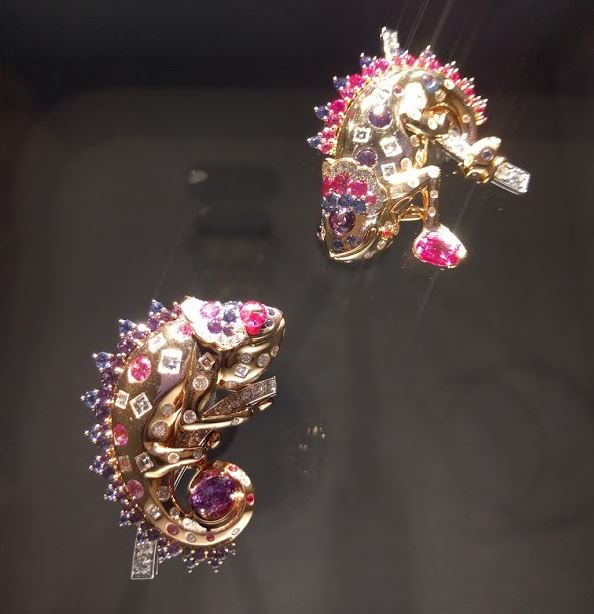
Last weekend I had the pleasure of embarking on an enticing visual journey curated by Van Cleef & Arpels’ interpretation of Noah’s Ark as imagined by famed set designer Robert Wilson.  The Parisian designer is known for producing masterful pieces of high jewelry that set a scene for the wearer or admirer.  The whimsical figures are expertly produced allowing a person’s focus to shift from execution into intention.  What is the story being told through the piece’s movement and color?

To immerse the viewer into the story of Noah’s Ark, Wilson selected an art space in Chelsea New York City, which he transformed into a page out of a children’s story book.  As we walked into the space, I needed to lower my head as if I was garnering passage upon a vessel.  Once inside I was encapsulated into a serene bluish room whose walls rippled like waves due to projected lighting.  Suspended from the ceiling was a wireframe wooden model of an ark, gently suggesting we had set sea and the only place that existed anymore was what was in the room.  Within the room were shadow boxes set into the walls beckoning us to peep in on the jeweled creatures inside as if they were residing in a stall on the ship.


What was on view was breathtaking, each animal was coupled with a partner as dictated in the old bible story having them boarded “two by two”.  Some jewels were expected, such as colorful sapphires and garnets, but there were unexpected treats on view as well such as snowflake obsidian carved into the likeness of rabbits.


One of my favorite minerals is jasper and I was elated to see it carved into a majestic depiction of resting rams.


Viewers were only given about 20 minutes to view the room, while experiencing light and sound effects articulating heavy rainfall.  Needless to say 20 minutes was not enough time for me to take it all in, thankfully the staff was very kind and allowed my friend and I to cycle through again while treating us with a canvas bag containing a booklet explaining the event.


On the second viewing I noticed a little more intention in the way the room was set up.  Similar colors and figures were set parallel from each other across the room.   Such as the geometrically heavy in design giraffe was set directly across from the similarly colored and set chameleon.  


The more polar like animals were set to the back of the room, decadent in pearls.


In the center of the wall a large opal with lively play of color and creatures giving off the illusion of movement.


And the feeling of texture.


The exhibit is on display for another week, more information can be found on the site here.


In celebration of the world renowned exhibit the Van Cleef & Arpels store is also displaying the jeweled creatures, though the same in figure, much different and warmer in hue.

The whole experience was otherworldly, giving a sleepy dreamlike illustration of a familiar story.

Tuesday, October 24, 2017

Ladies Night Art Crawl

Fall is my favorite time of year for several reason;, scarves, foliage, spiced cider, but most of all craft fairs.

My pumpkin spice fiance and I decided to enjoy the newly crisp fall air by moseying through the Ladies Night Art Crawl.  The event consisted of a string of predominantly female owned studio spaces opening their doors to the public to come look, touch, and buy made in Philly art.

Scrawled below is the map distributed by the vendors, the starting point being The Common Room , a creative space to curate woman created art.


There I came across two new artists to follow.  The first being Sadie Francis of Only in the Forest.  Francis has worked in the environmental field for 15 years, in doing so she carried her hobby over to shareable wearable art.  The flowers she encases in resin are found during long daily walks through Philadelphia’s expansive park system. I’ve seen this type of jewelry before, so what really makes these pieces poignant is knowing they’re local and made by someone who deeply cares about sustaining nature.  They’re not just flowers, they’re flowers from our community.


The second artist I came across was MEO-C.28  who created an exciting take on the necklace bib. She paints exaggerated baubles onto re-purposed fabric to create the look of a bib without the heft of it.  Light weight and handcrafted, these works give new life to a tired trend.


Last but not least is always a favorite of mine, Forge and Finish.  A trio of Temple ladies working together to handcraft jeweled treasures.  My current favorite collection is Talo, jeweled with a tasty bluish green tourmaline.  Forge and Finish does an excellent job of echoing shape between collections allowing a wearer to mix and match between collections. Each piece is a work of art with a slight edge that sets it aside from it’s peers. Very wearable while still making a statement.


Friday, September 15, 2017

Pyle on the Jewels

Fresh off the heels of New York Fashion Week a hunger was stoked for new fall style and it can be satiated by the independent artists featured at The Pool Trade Show this weekend taking place at the Jacob Javits Center in NYC.

One jewelry artist, Amy C Pyles, has an edgier collection perfect to invigorate anyone’s wardrobe that is really looking to bolden their style.

There is a strong energy in her jewelry that is brought to life with a repeating line motif found intermittent with leather and gem elements to create a striking visual palette.

Contemporary in foundation, Pyles incorporates non-traditional items like found vintage objects as a focal points and elevates their purpose by integrating them with various types of chain, her specialty.


I always love coming across work like Pyles’ because you can invest in one piece and it will serve you all season.  With this much versatility, you can easily style a new necklace or bracelet into your current outfit favorites to freshen them for fall.

If you’re in the NYC area this weekend be sure to check it out:


http://www.pooltradeshowbrandbook.com/


Monday, September 11, 2017

Acrylics in Fashion

Synthetic materials first appeared on the market for practical purposes, industrial purposes, and now for fashion purposes, trickling down into the realm of contemporary jewelry.  Clear acrylic plastics have taken the forefront of self expression by creating a sleek futuristic look.  

Harling Ross of Manrepeller harps on the needing to find a fall fashion identity, a refreshed styling to embrace the new season (ManRepeller).  The acrylics of Corey Moranis lend a helping hand of giving a structural presence without overbearing with color or overworked design (Corey Moranis).

Acrylic rods are heated and twisted into knotted shapes, taking a very utilitarian material, and forming it into a more nurturing organic shape.  The pieces are bold in size, but completely wearable in color and design.  Even the styling of the models on Moranis’ site aid to the new millenia feel of the pieces with their minimized makeup and slicked down hair.


The surge of synthetics in fashion is not a new concept, just becoming more mainstream. Instead of being reserved for high fashion or exhibition art, it now can be purchased and worn as streetwear. The Met in New York is showcasing this in it’s latest exhibition, The Secret Life of Textiles: Synthetic Materials on display until September 17th, 2017 (The Exhibit).

We’ll be seeing more and more synthetic materials in the accessory field as products like 3d printers and laser cutters become more available as household items allowing the everyday craft artist to discover and use the medium.  There is a fear that wearables will become cold, too computerized, and perfect, losing the human touch that makes jewelry so emotional.  However, a true craftsman will be able to overcome this feat as we see in Corey Moranis’ pieces. They are simple but have been very worked, creating value through the level of care and execution present.

It’s an exciting time in modern jewelry to have a chance to create a new chapter or wearables in our craft history.

Friday, August 25, 2017

Trend spotted, Wonder Woman Arms

The “bracelets of submission” are worn by DC comic book Amazon Diana Prince, better known as Wonder Woman.  Recently this comic book princess was depicted by Gal Gadot in the heroine’s record breaking silver screen debut.  Canonically the bracelets were a reminder for the Amazon women to balance their power.  If removed, the Amazon would rage into a destructive frenzy, but when worn, the cuffs are a tool of protection from harm.  We often seen Wonder Woman able to deflect bullets with her arm wear.

More than breathtaking cinematography, the film re-ignited the cuff jewelry trend.  Cuffs have always been around, since the ancient Romans to Disco Divas in the 70’s. I personally always associated them with my grandmother, since she liked loud costume jewelry and meticulously styled the perfect piece for every one of her outfits.  One of her staples was to have a large bangle pushed up her forearm. So naturally, I love that Gal Gadot’s depiction of Wonder woman has brought this accessory back to the forefront, empowering a new generation of women to wear bold jewelry.  


Gal Gadot graces this month’s Rolling Stone cover fully featuring her Wonder Woman arm gear. Here’s to hoping to see fashion editorials to follow suit of having large cuffs and Athenian styled dress for fall.

Below I took a look into some Philadelphia fall fashion inspiration for the inner Amazonian.


Wednesday, August 2, 2017

The Bonnie Ring

The Gangsters, Outlaws and Lawmen auction took place on June 24th in Boston, Massachusetts. The auction featured a ring crafted by the notorious American gangster, Clyde Chestnut Barrow. The piece was a gift to his sweetheart, Bonnie Elizabeth Parker, as a promise ring since the couple was never wed or able to do so during their intense two year courtship.  

Barrow and his brother Buck were both amateur craftsmen that made jewelry, leather-work, and woodwork during their time in Eastham Farm Prison in Texas. The “Bonnie Ring” was believed to have been made during Barrow’s time there from 1930 to 1932.


The three headed snake ring is most likely silver plated copper, and like most jewelry tells a story. The ring bears the hallmark of an arrow striking a music note, Barrow’s signature.  It’s well-known that the gangster had a passion for music, and the arrow is thought to be wordplay on his surname (B)arrow. The serpent is a Victorian symbol used to represent eternal love. The snake ring trend was popularized when Prince Albert gifted Queen Victoria an emerald set snake ring in 1840. We see that this fashion remained strong nearly a century later with the creation of “the Bonnie ring”.


Bonnie Parker lost this ring when the couple’s stolen 1933 Ford Model B was riddled by a hail of police gunfire in Sowers, Tx.  The couple fled on foot narrowly escaping arrest, leaving behind personal articles in the abandoned vehicle.  “The Bonnie Ring” was claimed by officer Schmid who led the ambush, and the ring remained with the Schmid family until this auction.

The “Bonnie Ring” sold for $25,000; much less than its predicted selling price of $40,000.

Though the ring is not comprised of precious material, it is lofty in its historical clout as a testament to the whirlwind lovestruck romance the two gangsters shared for one another and how they enamored America with their wild escapade that ultimately ended in their very romanticized demise.


Sources:

Wednesday, July 5, 2017

The Rockefeller Emerald, World's Most Expensive Emerald per Carat

In May Christie’s announced it would auction the famous Rockefeller Emerald at its New York location.  Mid June that promise came into fruition when Harry Winston bought the ring for $5.5 million, making it the most expensive emerald, per carat, ever sold.

The rare Colombian emerald stone is an untreated 18ct octagonal step cut that was purchased by John D. Rockefeller Jr. in 1930 as a gift for his wife.  The emerald was originally set as a brooch, then converted to a platinum ring by their son, David Rockefeller, when he inherited the stone in 1948.  The stone was set by the Rockefeller family jeweler Raymond Yard.

Photo courtesy of Christie's

Other notable stones that were held by the Rockefeller family was a 101.73ct flawless diamond that was also bought by Harry Winston for $26.7 million in 2013. Another is the 62ct Rockefeller Sapphire from Burma that was acquired by the family in 1934. The stone was cut by Pierre Cartier into a rectangular step cut and mounted into a brooch. The sapphire sold for $3 million at Christie’s New York in 2001.

Photo courtesy of Christie's


Harry Winston is accumulating these infamous stones in hopes of opening a Harry Winston museum in New York to house these significant gems.  


Sources:


Thursday, June 22, 2017

My Engagement Experience

I have spent a significant amount of my career finding the perfect ring for others, when finally last June came my turn.  Unconventionally I set out ring shopping with my mother.  Josh was open to me styling my own ring since jewelry is something I’m incredibly knowledgeable and passionate about.

To start, the best advice I can give is talk to your friends then try on everything before making any kind of decision. Try on styles that you would never imagine trying on, try the big stone and a small stone, try different metals, try everything. By doing this you’ll positively know when you found the perfect ring.  By talking with friends they will tell you where and who they went to, what they liked and didn’t like about the process. This really helps you to know what to expect when going to different shops.

My adventure started out just like that. I asked around and conceived a list of places to look, then tried on EVERYTHING, even if it wasn’t my style.

In the end I decided on a local jeweler Bario Neal. I knew I wanted a three stone style with a yellow center.  Why did I choose yellow? Well, I knew I was going with a simple design so I wanted a way to give the ring a personal twist. Having worked extensively with jewelry, I have seen so many engagement rings and really wanted something of my own that I have not seen repeatedly.  Also the journey of the yellow diamond intrigued me, so I liked the idea of having a little bit of history on my finger.

Photo by Bario Neal

Happy with my sketch, I waited for the jeweler to receive in a choice between two yellow cushion cut Kalahari diamonds from their contact in Namibia.  In cooperation with De Beers, this Namibian source mined and manufactured these diamonds. So not only am I aware of the origin of my stone, I also know I was ethically supporting the diamond economy locally in Africa.  Having this much information about my ring really got me curious and I further delved into how the yellow diamond came about as a engagement choice historically.

I found that India has been the birthplace for some of the world’s most incredibly colored stones.  These stones were very much part of past Indian culture. In fact, different colored diamonds were used within India’s caste system in the sixth-century.  

Brahmins, the priests and rulers, had white to colorless diamonds.
Landowners and warriors were defined by brown diamonds.
The merchant class, yellow. The lower classes then had heavily included grayish to black diamonds.

Beyond using colored stones as an identifying tool, fancy colored diamonds were seen as a nuanced novelty.  They did not garner popularity until the discovery of the Australian Argyle Mine in the 1980’s.

Now we have coined trade terms such as Canary and Champagne as well as other tantalizing titles to describe a diamond's color.

A diamond's journey to discovery is an arduous one where nature incubates the stone into existence in a very specific way.  The mineral carbon under intense heat and pressure within the earth’s mantle is nature’s recipe for a diamond.  Once created that diamond is then carried to the earth’s surface by a release in pressure, often some sort of volcanic activity.

Colored diamonds are produced because of the presence of trace elements. In my yellow diamond’s case, nitrogen is the reason for color the stone. The amount of nitrogen determines the color intensity. I loved the softness of the yellow in my stone in contrast to the hard yellow color of the 18 karat metal I chose.  The stone had a delicate feel, giving off a nurturing sensitivity about the beginning of this new part of Josh and I’s relationship.  It fit exactly how I felt.


So on top of color I was intrigued by story that this particular diamond had to tell, it became unique to me as well as being aesthetically pleasing to my taste.

You can check out Bario Neal's Spring 2017 collection here as well as other fun jewels:
http://bario-neal.com/


WJA Philly Round Table - F. Walter Lawrence & Gustav Manz Desert Brooch

 2020 has been a whirlwind of a year, but I have been thankful to be able to stay connected with my peers through a series of virtual artist...