Showing posts with label art history. Show all posts

Sunday, December 6, 2020

WJA Philly Round Table - F. Walter Lawrence & Gustav Manz Desert Brooch

 2020 has been a whirlwind of a year, but I have been thankful to be able to stay connected with my peers through a series of virtual artist talks hosted by the Women's Jewelry Association.

These talks allowed for a more focused platform of sincere conversation that is not diluted by the distractions a typical studio tour (office pets, bench set up, etc). Though I yearn to get back to normalcy, I do appreciate getting to know each member more intimately.

 I'm was very excited for our year end event - WJA Philly Round Table

Here, each member had the opportunity to introduce themselves and their work! 

My contribution is one of the more interesting pieces that has come through Wilson's Estate Jewelry - 

The Desert Brooch.


This remarkable piece was commissioned by Frank Walter Lawrence and produced by esteemed Arts & Crafts artist Gustav Manz, circa 1901. During his travels, Lawrence procured a piece of Phoenician glass from Old Jerusalem. The fragment itself is a tremendously profound artifact of an ancient city, but its destiny was to be displayed in a wrought 14 karat gold frame as an imaginative Middle Eastern sunset.

Manz masterfully crafted a surround of whiplashed gold as stylized lotus and vigorously rendered palm trees. This centers a depiction of two pyramids towering over a line of camels led by a lone rider, unintimidated by the grandeur of his environment. The Phoenician glass serves as the vehicle for an expansive sky, smokey and translucent, glowing as a burgundy twilight.


The piece was exhibited at the Louisiana Purchase Exposition in 1904 as well as published as a feature in Town & Country the same year.

After this however, the brooch disappeared for over a century, until 2019 when it resurfaced at an auction and was purchased by my employer. There was an inclination towards what we had found since stylistically the piece is reminiscent of Manz's work, but with no signature and a lack of provenance we were forced to continue our research. 


I'm always ensnared by the journey that our investigation unfolds for us, but this was an instance where we genuinely felt like Ben Gates in National Treasure, peeling back layers of a mysterious artifact to unravel its story. 

The story brought us to Gustav Manz's great-granddaughters who published a blog that was the very piece we were trying to authenticate! We had the pleasure to meet with them and observe the brooch together with a collective sigh of appreciation. 

The piece wanders into my mind often, not only because of its craftsmanship, but because of how it silently was able to emit its foothold in jewelry history. 

Photos courtesy of Wilson's Estate Jewelry & Gustav Manz & Co.


Wednesday, October 17, 2018

Heaven Bodies Retrospective


My fascination with religious iconography derives from the notion that there was once a time where the majority was illiterate, inciting a need for symbols and color coding to propagate church literature. That story was further built upon as humanity developed, and now, we see these once instrumental designs used to create depth in fashion, movies, music, etc.

The Met this summer hosted the exhibition "Heavenly Bodies" ,which I must confess has been my favorite Met Gala theme by light years. Taking the wardrobe that has been reserved for the elite of the church and having it perverted by the royalty of Hollywood in their self importance is a historical parallel that probably makes every art history nerd giggle with glee.  Having grown up in the Catholic church, I'm very aware articles of clothing are indicative of status within the church.  Different outfits mean you rank a certain way, so having Rihanna dress as the highest church rank possible, that takes a lifetime to achieve, and a vote to secure, cracks me up especially since she is a woman doing so.  And above all else, the outfit was stunning, as was it's counter part in the exhibition by John Galliano for Christian Dior.


Walking into the exhibition you are swallowed by the scintillating gold mosaic, jewelry, and vestments lit and alive under the museum hot lights. On one side a line of Byzantine mosaic inspired Dolce & Gabbana dresses, the other side a more modern aesthetic of 90's Gianni Versace garments.


The dresses were displayed above the viewer, forcing you too look up with the same devotion you would show an alter or stain glass in a church.  The importance dictated by position, setting the mood of the show. The Met's permanent collection surrounded this linear path that pulled you along deeper into the museum.

The common thread of the first two rooms was gold. Encased were ancient relics of a time when Christianity was new and Justinian & Theodora were attempting to make Rome great again. Metal-smiths painstakingly planishing containers of gold, hoping not to tear the thinning metal, or else the project would be lost.


Tiny beads of granulation individually placed by a trembling hand with no modern assistance or convention, just mastery.


Stones primitively set either by carefully cut inlay or by crushing the stone into place.


Bezel set cabochon stones, the idea of faceting a distant invention. Instead, the mineral is half drilled and set on a peg to secure the stone within its gilded casing. The peg not even hidden as it is today with pearls. It shows through the middle of the translucent stones, taking the viewer away from the color of the gem and back to the reality that this was the technique of the time.


Bloodstone made an appearance as expected considering it's mythos of being the rock at the base of the Crucifixion Cross, speckled with Christ's blood.


Imitating the floor plan of a basilica, you are carried down these first rooms, like aisles, to where the exhibition really opens up dumping you into two larger more open rooms.  Before the grand reveal, you are corralled and crowded in a tiny area where visitors attempted to see the Reliquary Cross and the duo of leather jackets paying homage by Versace and Christian Lacroix. Faces pressed to glass.


In the same claustrophobic area, Chanel's cross woven vest loomed over early Christian artifacts, once used as tools for prayer, now fashion ornamentation. This point driven further home by the garish display of Chanel cross bangles, massively not humble, contrasting it's calmer predecessors. The juxtaposition of 2d geometric byzantine art to the garish bejeweled Chanel.


Also produced by Chanel, we have the  18kt rock crystal crosses sharing a case with an authentic Byzantine cross necklace. The crystal was believe to be representative of the resurrected Christ and a metaphor for the "river of life."


With a sigh of personal space and drastic temperature change, you enter the cool open gallery representing the width breadth of a domed basilica.

Inside you were met with throngs of people, foreign and domestic, to see famous fashion houses re-tell the story of religious vestment.  A cacophony of mixed tongues whispered in awe of the cornucopia of art and design sprawled throughout the room. An outfit design conversing with the painting that gave it muse. Watching the merriment of old christian foundation intertwine and give life to the modern reinterpretation.


I spent the better part of my afternoon there and it still didn't feel like enough.  It was absolutely remarkable how the seamlessly incorporated the permanent collection meshed with the borrowed couture bringing together history nerds and fashion enthusiasts to celebrate one theme.  The Met set the bar very high, especially considering it was the most visited exhibit in it's history, clocking in at just over 1.5 million visitors.


Friday, September 21, 2018

Gold Rush

There were several gold rushes throughout history which drew droves of eager prospectors from all over to an area pregnant with the promise of wealth and prosperity to those lucky enough to find the golden nuggets nestled waiting within the earth's crust.

This image sprang to mind while reading that an Australian man recently uncovered a large amount of gold in the northern goldfields of western Australia worth up to $110,000.  I really hadn't realized that the dream of striking gold was still alive for some.  Then I really thought about it, where does gold even come from?

Recently discovered "Duckfoot"

For years I've written on the history of gemstones and jewelry and why they are so preciously expensive, but why is gold precious?

Gold is an element and lives on the periodic table as a transitional element with the atomic number of 79.  It is considered to be one of the least reactive chemical elements and is the most noble of all the noble metals, making it the most resistant to corrosion.

Gold is considered very rare since it is believed there is only a finite amount in the solar system that was present as dust the day it formed. So whatever we have on earth is what we get, it does not have a recipe to form like a gemstone does. It is an element created on a celestial level and cannot be reproduced.  Gold ore is found in solid form usually as a nugget, granular, or in veins, but also exists as flakes and dust.  Gold does not have a habit formation like a gemstone does further proving it is the most malleable of all the metals.  When found during mining, what is being found is gold that is by chance clumped together in a mine-able form, and sometimes this gold is naturally alloyed with other elements and is not pure. To get pure gold, it must be refined to extract impurities and other metals.


Gold in it's purest form is very soft and to be used for jewelry needs to be alloyed with another metal for strength and sometimes color.

The most familiar karats of gold are:

10K or .417 meaning 41.7% pure gold alloyed with other metals like silver, copper, zinc, and/or nickel.

14K or .585 meaning 58.5% pure gold alloyed with other metals.

18K or .750 meaning 75% pure gold alloyed with other metals.

24K  or 999.9 is considered fine gold at 99.95% pure gold.

10k is much harder and more durable than 18k or 24k but not as rich in color is the main difference between these karats besides gold content and price.

For example I chose 18k for my engagement ring because it's rich color to matched my yellow center, and I know I'd be gentle with my ring knowing that it will be more susceptible to scratches and nicks.  For someone hard on their jewelry I always recommend 10k or 14k.

Tuesday, July 3, 2018

Happy Fourth of July from America's Largest Diamond

In honor of the Fourth we're taking a look at the largest American found
diamond, Uncle Sam.


Discovered by Wesley Oley Basham, Uncle Sam was unearthed in 1924 from the Prairie Creek Pipe Mine in Murfreesboro, Arkansas.  The hefty rough was named after Basham’s nickname “Uncle Sam” and weighed in at 40.23 carats. Its discovery drew attention to the failing Arkansas Diamond Corporation, rescuing the company from its debt and inevitable closure that winter.  Now the mine is known as The Crater of Diamonds State Park. It is the only mine in the world open to the public and has become a popular vacation destination for American rockhounds.

Uncle Sam was decided to be stylized as an 12.42 carat emerald cut fashioned by
Schenck & Van Haelen of New York. The stone was graded as an M in color, for it has been described to be a pale brown or slightly pink.  The VVS1 clarity was demonstrated beautifully in the stepped facets as a viewer could not see an inclusion without the assistance of a loupe.


Uncle Sam was sold to a private collector in 1971 for $150 million and is unfortunately not
on display but is still a celebrated American treasure.


From Uncle Sam, have a very happy and safe Fourth of July!


Sources:
http://www.craterofdiamondsstatepark.com/
https://en.wikipedia.org/wiki/Uncle_Sam_(diamond)


Sunday, June 17, 2018

Admiring the Strength of the Elephant

One of my favorite animals is the elephant.  They're majestically massive and at the same time incredibly intuitive and nurturing.  They are complex creatures which explains why they are so prominent as a motif in several cultures.  Here I'm wearing some of my favorite LAGOS pieces while taking a look at the iconography of the elephant.


One of the most popular depictions of the elephant is through the Hindu religion.  The god Ganesha is easily identifiable with his large elephant head on a human body.  His likeness will be found across South Asia in countries like India, Nepal, and Thailand.  Ganesha is a patron of the arts and sciences and looked upon as the remover of obstacles.  A steadfast god to look to in times of trial.


In Buddhism you will find the presence of the elephant pair Kangiten, represented as male and female elephant headed humanoid figures embracing as a symbol of the unity of opposites.  Enforcing the belief of the oneness of all things though they may be seemingly different.


In Islam, the Quran has a chapter entitled "The Elephant".  A story of a Abraha's white elephant, Mahmud, that refused to cross into Mecca, foiling Abraha's plan to lead Yemen to conquer the holy city.  Mahmud could not be persuaded to cross by reason or violence, once again depicting the elephant as a creature of intelligence and resolve.

The elephant is not indigenous to Europe but was discovered through their exploration or Asia. Awed by the ferocity of the war elephant in battle, Europe adopted the beast as a symbol of militaristic strength. Napoleon even commissioned a giant cast bronze elephant fountain to be made from guns confiscated in victorious battle.  The fountain was never completed (hello Waterloo).


America adopted the elephant to represent the Republican party in 1884.  The origin is a political cartoon done by Thomas Nash.  The elephant is shown charging in dispersing other smaller animals representing other political interests at the time.  Another account of dominance and strength.


Lastly Elephants are native to Africa and usually where most people imagine them. In Africa the elephant is revered for its strength, wisdom, and memory. The elephant was depicted on several coat of arms throughout time in Africa including South Africa, The Ivory Coast, the kingdom of Laos, and the kingdom of Dahomey.


Globally you can see the elephant is respected and admired for it's strength, it is looked to for it's wisdom, and it is a symbol of conquering obstacles and embracing change.


Sunday, November 12, 2017

Van Cleef & Arpels' Noah's Ark Exhibition

Last weekend I had the pleasure of embarking on an enticing visual journey curated by Van Cleef & Arpels’ interpretation of Noah’s Ark as imagined by famed set designer Robert Wilson.  The Parisian designer is known for producing masterful pieces of high jewelry that set a scene for the wearer or admirer.  The whimsical figures are expertly produced allowing a person’s focus to shift from execution into intention.  What is the story being told through the piece’s movement and color?

To immerse the viewer into the story of Noah’s Ark, Wilson selected an art space in Chelsea New York City, which he transformed into a page out of a children’s story book.  As we walked into the space, I needed to lower my head as if I was garnering passage upon a vessel.  Once inside I was encapsulated into a serene bluish room whose walls rippled like waves due to projected lighting.  Suspended from the ceiling was a wireframe wooden model of an ark, gently suggesting we had set sea and the only place that existed anymore was what was in the room.  Within the room were shadow boxes set into the walls beckoning us to peep in on the jeweled creatures inside as if they were residing in a stall on the ship.


What was on view was breathtaking, each animal was coupled with a partner as dictated in the old bible story having them boarded “two by two”.  Some jewels were expected, such as colorful sapphires and garnets, but there were unexpected treats on view as well such as snowflake obsidian carved into the likeness of rabbits.


One of my favorite minerals is jasper and I was elated to see it carved into a majestic depiction of resting rams.


Viewers were only given about 20 minutes to view the room, while experiencing light and sound effects articulating heavy rainfall.  Needless to say 20 minutes was not enough time for me to take it all in, thankfully the staff was very kind and allowed my friend and I to cycle through again while treating us with a canvas bag containing a booklet explaining the event.


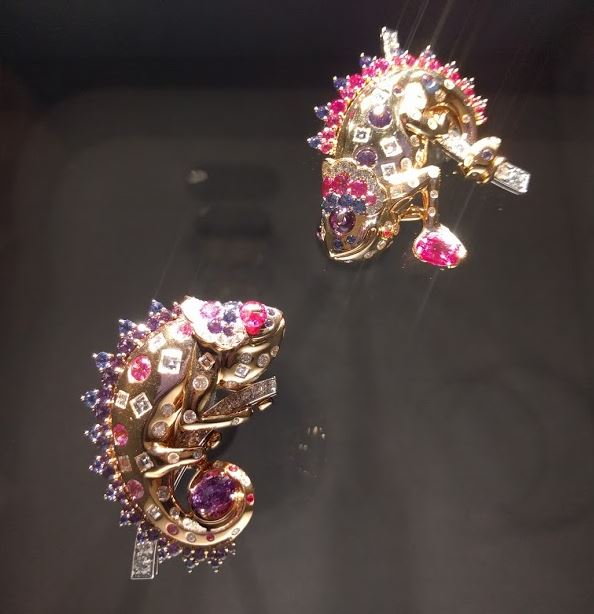
On the second viewing I noticed a little more intention in the way the room was set up.  Similar colors and figures were set parallel from each other across the room.   Such as the geometrically heavy in design giraffe was set directly across from the similarly colored and set chameleon.  


The more polar like animals were set to the back of the room, decadent in pearls.


In the center of the wall a large opal with lively play of color and creatures giving off the illusion of movement.


And the feeling of texture.


The exhibit is on display for another week, more information can be found on the site here.


In celebration of the world renowned exhibit the Van Cleef & Arpels store is also displaying the jeweled creatures, though the same in figure, much different and warmer in hue.

The whole experience was otherworldly, giving a sleepy dreamlike illustration of a familiar story.

Wednesday, August 2, 2017

The Bonnie Ring

The Gangsters, Outlaws and Lawmen auction took place on June 24th in Boston, Massachusetts. The auction featured a ring crafted by the notorious American gangster, Clyde Chestnut Barrow. The piece was a gift to his sweetheart, Bonnie Elizabeth Parker, as a promise ring since the couple was never wed or able to do so during their intense two year courtship.  

Barrow and his brother Buck were both amateur craftsmen that made jewelry, leather-work, and woodwork during their time in Eastham Farm Prison in Texas. The “Bonnie Ring” was believed to have been made during Barrow’s time there from 1930 to 1932.


The three headed snake ring is most likely silver plated copper, and like most jewelry tells a story. The ring bears the hallmark of an arrow striking a music note, Barrow’s signature.  It’s well-known that the gangster had a passion for music, and the arrow is thought to be wordplay on his surname (B)arrow. The serpent is a Victorian symbol used to represent eternal love. The snake ring trend was popularized when Prince Albert gifted Queen Victoria an emerald set snake ring in 1840. We see that this fashion remained strong nearly a century later with the creation of “the Bonnie ring”.


Bonnie Parker lost this ring when the couple’s stolen 1933 Ford Model B was riddled by a hail of police gunfire in Sowers, Tx.  The couple fled on foot narrowly escaping arrest, leaving behind personal articles in the abandoned vehicle.  “The Bonnie Ring” was claimed by officer Schmid who led the ambush, and the ring remained with the Schmid family until this auction.

The “Bonnie Ring” sold for $25,000; much less than its predicted selling price of $40,000.

Though the ring is not comprised of precious material, it is lofty in its historical clout as a testament to the whirlwind lovestruck romance the two gangsters shared for one another and how they enamored America with their wild escapade that ultimately ended in their very romanticized demise.


Sources:

Saturday, April 2, 2016

Happy Easter, Let's look at the Diamond Jubilee Faberge Egg


In honor of Easter I figured I could post about a Faberge Egg that has been capturing my eye for awhile. It was created for the 2012 Diamond Jubilee, celebrating Queen Elizabeth II’s 60th anniversary as Queen Regent.  A Diamond Jubilee was only celebrated once before for the beloved Queen Victoria in 1897. 


In the Queen’s honor, Faberge constructed an egg utilizing 500 grams of rose gold and set it with 60 stones, a stone to represent each year of the Queen's reign.  The stones used were diamonds, rubies, emeralds, and sapphires to create a colorfully playful echo of Faberge's Matelasse Jewelry Collection. 


The 2012 Matelasse Collection is a contemporary design based off the vintage quilting motif found in the Romanov Palace, specifically Queen Alexandra’s Salon the Mauve Room in the Alexander Palace in Tsarskoe Selo, Saint Petersburg Russia. The Mauve Salon had a soft violet opal hue, chosen by the Empress Alexandra herself to honor a lilac that her husband Tsar Nicholas had given to her.  The room was incredibly chic for it’s time in 1896, which Faberge emulates using the soft feminine hue of rose gold metal.  The criss cross pattern used in the jewelry masterfully makes metal look like the soft cushions used in the Empress’ boudoir,  even embellishing where the lines intersect with a stone, the same as a cushion would have a button.  


It was the Imperial Russian Family who originally commissioned Fabrege to create the ornate eggs in 1885, as a Easter gift,continuing the tradition yearly until 1917 (further history can be found here: http://www.faberge.com/news/49_imperial-eggs.aspx).  So it was no surprise that the brilliant goldsmithing company would draw it’s inspiration for Queen Elizabeth II’s gift from the originating egg family.


Sources:


WJA Philly Round Table - F. Walter Lawrence & Gustav Manz Desert Brooch

 2020 has been a whirlwind of a year, but I have been thankful to be able to stay connected with my peers through a series of virtual artist...