Showing posts with label Diamonds. Show all posts

Tuesday, July 3, 2018

Happy Fourth of July from America's Largest Diamond

In honor of the Fourth we're taking a look at the largest American found
diamond, Uncle Sam.


Discovered by Wesley Oley Basham, Uncle Sam was unearthed in 1924 from the Prairie Creek Pipe Mine in Murfreesboro, Arkansas.  The hefty rough was named after Basham’s nickname “Uncle Sam” and weighed in at 40.23 carats. Its discovery drew attention to the failing Arkansas Diamond Corporation, rescuing the company from its debt and inevitable closure that winter.  Now the mine is known as The Crater of Diamonds State Park. It is the only mine in the world open to the public and has become a popular vacation destination for American rockhounds.

Uncle Sam was decided to be stylized as an 12.42 carat emerald cut fashioned by
Schenck & Van Haelen of New York. The stone was graded as an M in color, for it has been described to be a pale brown or slightly pink.  The VVS1 clarity was demonstrated beautifully in the stepped facets as a viewer could not see an inclusion without the assistance of a loupe.


Uncle Sam was sold to a private collector in 1971 for $150 million and is unfortunately not
on display but is still a celebrated American treasure.


From Uncle Sam, have a very happy and safe Fourth of July!


Sources:
http://www.craterofdiamondsstatepark.com/
https://en.wikipedia.org/wiki/Uncle_Sam_(diamond)


Wednesday, February 21, 2018

How Does The Lesotho Diamond Measure Up?

Early this year the world’s fifth largest gem-quality rough diamond was found at Lesotho
Africa’s Letseng mine. D in color and weighing in at 910 carats, the gem is the largest
diamond to have been found in that particular mine and is estimated to be worth
$40million.

The size is striking, comparable to a baseball in size and weight, but how does it measure
up to other large gem-quality diamonds found?


Starting with the most famous and by far the largest gem-quality rough diamond ever found,
the Cullinan.  It was discovered by Thomas Cullinan from the Premier No. 2 Mine in Cullinan,
South Africa in 1905. Weighing a whopping 3106.75 carats, the stone was ultimately cut into
9 stones total by the Asscher brothers.  The Cullinan I and II were used in the British Crown
Jewels while the other 7 stones remained with the Asscher family.  Even cut, the Cullinan is
still record holding.

The Cullinan I is the world’s largest clear cut diamond weighing in at 530.4 carats and D in
color. This Great Star of Africa, currently resides in the scepter of the British Crown Jewels
on display at the Tower of London.

The Cullinan II, the Lesser Star of Africa, is that second largest clear cut diamond weighing
in at 317.4 carats.  This stone is also part of the British Crown Jewels, set in the front of the
Imperial State Crown below the Black Prince’s Ruby (famously misnamed and is actually a red spinel).


The second largest gem-quality rough diamond is the Lesedi La Rona. It was found in the
Karowe Mine of Botswana in 2015 weighing in at 1109 carats.  The stone was purchased in
2017 by Graff Diamonds and has since been cut into smaller sellable stones.


Then we have the Excelsior Diamond which was the world’s largest gem-quality rough
diamond prior to the discovery of the Cullinan and is currently ranked third among its peers
in that category at 970 carats. The Excelsior Diamond was found in 1893 at the Jagersfontein
Mine in South Africa and has since tragically been cut into 21 insignificant stones that were
sold to several different buyers. One of the famous jewelry pieces to come from this stone is
a bracelet holding the 69.68 carat pear Excelsior I.  The stone was cut by the Asscher
Diamond Company in 1903 and eventually sold to and set by Robert Mouawadin 1996.


Finally we have the fourth largest gem-quality stone, the Star of Sierra Leone, extraordinarily
close in weight to the Excelsior Diamond at 968.9 carats. It is the largest alluvial diamond
ever discovered and was uncovered by miners in 1972 in the Diminco alluvial mines in Sierra
Leone. Harry Winston purchased the diamond and had it cut into 17 stones. Six of these
diamonds are present in Harry Winston’s “Star of Sierra Leone” brooch.


It seems that Africa is still the juggernaut when it comes to large gem-quality rough.
Impressively, only two of these diamonds are known to have been found using modern LDR
technology, the Lesedi La Rona and the Lesotho.

I can’t wait to see if how this magnificent stone ends up, whether it is cut into several smaller
pieces to be auctioned or if a mighty stone is cut and set into a work of art. Either way it is
definitely a stone to stay tuned into.

Monday, November 27, 2017

Royal Engagement

Another heirloom is added to the royal jewelry collective now that Prince Harry and Meghan Markle have recently become engaged.


Prince Harry worked with Queen Elizabeth II’s trusted jeweler, Cleave and Company, to craft a brilliantly meaningful ring.


The center stone is sourced from Botswana, a place significant to the couple since they enjoyed a camping trip there just weeks after first meeting.  The ring carries a literal piece of the land as a beautiful reminder of the galvanized beginnings of their romance.


The two side stones were taken from Princess Diana’s jewelry collection which was left to Prince William and Harry upon her death.

Using life as inspiration for developing the ring, Prince Harry notes, “It’s incredibly special. And you know to be able to have this [the ring] which sort of links where you come from and Botswana which is important to us. It’s perfect.”


The three stone yellow gold ring is an instant classic and will surely influence many 2018 proposals just as Princess Diana’s velvety sapphire ring has done for nearly 40 years.

Congratulations to the Royal Couple!


Sources:


Sunday, November 12, 2017

Van Cleef & Arpels' Noah's Ark Exhibition

Last weekend I had the pleasure of embarking on an enticing visual journey curated by Van Cleef & Arpels’ interpretation of Noah’s Ark as imagined by famed set designer Robert Wilson.  The Parisian designer is known for producing masterful pieces of high jewelry that set a scene for the wearer or admirer.  The whimsical figures are expertly produced allowing a person’s focus to shift from execution into intention.  What is the story being told through the piece’s movement and color?

To immerse the viewer into the story of Noah’s Ark, Wilson selected an art space in Chelsea New York City, which he transformed into a page out of a children’s story book.  As we walked into the space, I needed to lower my head as if I was garnering passage upon a vessel.  Once inside I was encapsulated into a serene bluish room whose walls rippled like waves due to projected lighting.  Suspended from the ceiling was a wireframe wooden model of an ark, gently suggesting we had set sea and the only place that existed anymore was what was in the room.  Within the room were shadow boxes set into the walls beckoning us to peep in on the jeweled creatures inside as if they were residing in a stall on the ship.


What was on view was breathtaking, each animal was coupled with a partner as dictated in the old bible story having them boarded “two by two”.  Some jewels were expected, such as colorful sapphires and garnets, but there were unexpected treats on view as well such as snowflake obsidian carved into the likeness of rabbits.


One of my favorite minerals is jasper and I was elated to see it carved into a majestic depiction of resting rams.


Viewers were only given about 20 minutes to view the room, while experiencing light and sound effects articulating heavy rainfall.  Needless to say 20 minutes was not enough time for me to take it all in, thankfully the staff was very kind and allowed my friend and I to cycle through again while treating us with a canvas bag containing a booklet explaining the event.


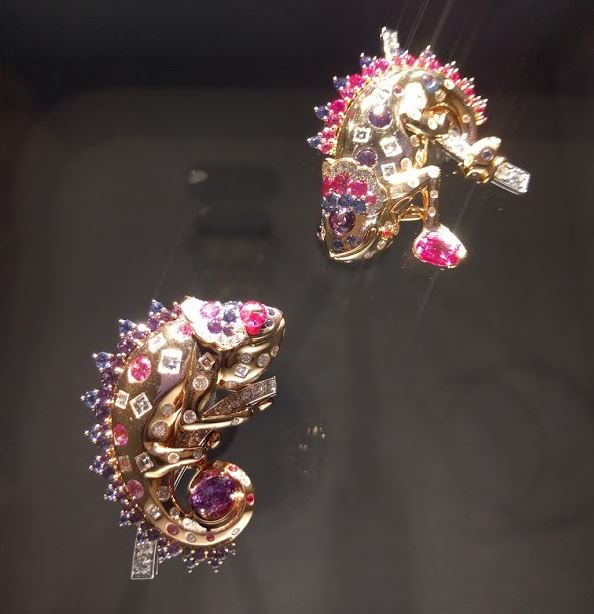
On the second viewing I noticed a little more intention in the way the room was set up.  Similar colors and figures were set parallel from each other across the room.   Such as the geometrically heavy in design giraffe was set directly across from the similarly colored and set chameleon.  


The more polar like animals were set to the back of the room, decadent in pearls.


In the center of the wall a large opal with lively play of color and creatures giving off the illusion of movement.


And the feeling of texture.


The exhibit is on display for another week, more information can be found on the site here.


In celebration of the world renowned exhibit the Van Cleef & Arpels store is also displaying the jeweled creatures, though the same in figure, much different and warmer in hue.

The whole experience was otherworldly, giving a sleepy dreamlike illustration of a familiar story.

Thursday, June 22, 2017

My Engagement Experience

I have spent a significant amount of my career finding the perfect ring for others, when finally last June came my turn.  Unconventionally I set out ring shopping with my mother.  Josh was open to me styling my own ring since jewelry is something I’m incredibly knowledgeable and passionate about.

To start, the best advice I can give is talk to your friends then try on everything before making any kind of decision. Try on styles that you would never imagine trying on, try the big stone and a small stone, try different metals, try everything. By doing this you’ll positively know when you found the perfect ring.  By talking with friends they will tell you where and who they went to, what they liked and didn’t like about the process. This really helps you to know what to expect when going to different shops.

My adventure started out just like that. I asked around and conceived a list of places to look, then tried on EVERYTHING, even if it wasn’t my style.

In the end I decided on a local jeweler Bario Neal. I knew I wanted a three stone style with a yellow center.  Why did I choose yellow? Well, I knew I was going with a simple design so I wanted a way to give the ring a personal twist. Having worked extensively with jewelry, I have seen so many engagement rings and really wanted something of my own that I have not seen repeatedly.  Also the journey of the yellow diamond intrigued me, so I liked the idea of having a little bit of history on my finger.

Photo by Bario Neal

Happy with my sketch, I waited for the jeweler to receive in a choice between two yellow cushion cut Kalahari diamonds from their contact in Namibia.  In cooperation with De Beers, this Namibian source mined and manufactured these diamonds. So not only am I aware of the origin of my stone, I also know I was ethically supporting the diamond economy locally in Africa.  Having this much information about my ring really got me curious and I further delved into how the yellow diamond came about as a engagement choice historically.

I found that India has been the birthplace for some of the world’s most incredibly colored stones.  These stones were very much part of past Indian culture. In fact, different colored diamonds were used within India’s caste system in the sixth-century.  

Brahmins, the priests and rulers, had white to colorless diamonds.
Landowners and warriors were defined by brown diamonds.
The merchant class, yellow. The lower classes then had heavily included grayish to black diamonds.

Beyond using colored stones as an identifying tool, fancy colored diamonds were seen as a nuanced novelty.  They did not garner popularity until the discovery of the Australian Argyle Mine in the 1980’s.

Now we have coined trade terms such as Canary and Champagne as well as other tantalizing titles to describe a diamond's color.

A diamond's journey to discovery is an arduous one where nature incubates the stone into existence in a very specific way.  The mineral carbon under intense heat and pressure within the earth’s mantle is nature’s recipe for a diamond.  Once created that diamond is then carried to the earth’s surface by a release in pressure, often some sort of volcanic activity.

Colored diamonds are produced because of the presence of trace elements. In my yellow diamond’s case, nitrogen is the reason for color the stone. The amount of nitrogen determines the color intensity. I loved the softness of the yellow in my stone in contrast to the hard yellow color of the 18 karat metal I chose.  The stone had a delicate feel, giving off a nurturing sensitivity about the beginning of this new part of Josh and I’s relationship.  It fit exactly how I felt.


So on top of color I was intrigued by story that this particular diamond had to tell, it became unique to me as well as being aesthetically pleasing to my taste.

You can check out Bario Neal's Spring 2017 collection here as well as other fun jewels:
http://bario-neal.com/


Friday, May 19, 2017

Artemis and Apollo, the world's most expensive earrings

In Greek mythos Apollo and Artemis are the twin offspring of Zeus and Leto.
Artemis is revered as the Greek goddess of the Hunt, her brother Apollo is revered as the Greek god of medicine and healing, also known to bring illness and plague.

In the gem world the twins Apollo and Artemis are known as the world’s most expensive earrings, selling for $57.4 million at the Sotheby’s 2017 Magnificent Jewels and Noble Jewels auction held in Geneva on May 16th.


The pair was originally estimated to sell for around $70 million and were believed to be sold off separately.  However a private buyer preserved the romanticism of the twin earrings by purchasing them as set.

Artemis is 16ct VVS2 pink pear diamond that was purchased for $15.3million while her brother Apollo, a flawless 14.54ct pear, sold for much more at $42.1 million.  This is because Apollo has a rarer deep vivid blue coloring caused by its exposure to the element boron during formation.
Adding to Apollo’s legacy it is documented to have been sourced from the famed Cullinan Mine in South Africa.  Yes, the same mine responsible for the British Crown Jewels.


Since the pair went to a private buyer, they are unlikely to be seen for some time, so hopefully those able to attend the auction were able to revel in their cosmically named brilliance.


Sources:
https://www.gemkonnect.com/news/diamond-earrings-fetch-record-574m-sotheby’s-geneva-auction
http://frame.bloglovin.com/?post=5597365757&blog=10937893&frame_type=feed


Monday, February 27, 2017

Charlize Theron wearing "Garden of Kalahari"


Charlize Theron elevated her pleated gold Dior dress with showstopping asymmetrical diamond drop earrings from Chopard’s “Garden of Kalahari” collection.

Crafted using fairmined 18 karat white gold and weighing in at 59.9 carats, the earrings are the definition of dripping in diamonds.


Twenty-three diamonds form the “Garden of Kalahari” collection, all cut from a single 342 carat rough diamond dubbed “The Queen of Kalahari”.
The designs are the brainchild of artisan Caroline Scheufele, who masterfully created an enchanted garden scene depicted by these breathtaking jewels.


The neckpiece is the focal point of the collection but was not worn by Theron.  It can be worn four different ways to drape the neckline in a whimsical garden theme.   


Two of the pendants of the necklace can detach and be worn as the earrings as shown on Theron.

The modified earrings mesmerize as the mismatched pear and heart stones are both graded a D in color and are flawless in clarity.  The heart is slightly heavier at 26 carats while the pear weighs in at 25 carats. The dazzling stones are accentuated by 4.35 carats worth of brilliant cut diamonds.

Charlize Theron’s choice in jewelry demonstrated that timeless craft can captivate when artfully showcased for the world to see, enrapturing with it’s unique brilliance.


Source:

http://www.chopard.com/intl/diary/the-garden-of-kalahari/


Friday, December 16, 2016

Shirley Temple Jewels featured in Heritage Auction Holiday Sale

Art is a time stamp, you can know what an era was like by looking at a piece of work it left behind.  What the values were, what was interesting to the time, and of course the fashion.  Art is timeless in that it will always be beautiful no matter how much the world has changed, and in its beauty it holds little clues of how we developed to be where we are now.


Jewelry is unique in how personal and intimate it can be; It is worn, loved, and often a keepsake.  A memory of a relative, a gift from a significant other, a reward for a personal achievement.  It gets passed along the generations until the sentiment is lost and what is left is its clue to history.  Seeing people unearth new gemstones and creating new ways to cut and mount them.  We can see in a piece of jewelry how it was made, what the technology was for that time, what was being discovered.  The shift from rose cut stones to the faceting we have today was part of a scientific revolution. Going from hand cut and having to reflect candlelight, to being laser cut to reflect fluorescent lights.  We see progression but that doesn’t make the old any less beautiful or unwanted.


Early in December we got to see a piece of history with Heritage Auction’s Holiday Signature Sale, showcasing over 2,000 jewels to bid on, 80 of which belonged to Shirley Temple.


We can see an expansive timeline of incredible works. Some are common but extraordinarily set, while some stones are so exotic they don’t even need to be mounted to be valued.

I chose some of my favorites of the sale to share below.

Shirley Temple, Cartier Lapis and Turquoise Ring

Shirley Temple, Cartier Lapis, Pearl Tassel

Shirley Temple, Multi-Stone Brooch
Created by Lebon & B.


Shirley Temple, Lapis Dragon Cuff
Shirley Temple, Ruby and Dia Platinum Bracelet

Shirley Temple, Jade, Ruby, and Sapphire


Shirley Temple, Platinum Yellow Dia Ring


WJA Philly Round Table - F. Walter Lawrence & Gustav Manz Desert Brooch

 2020 has been a whirlwind of a year, but I have been thankful to be able to stay connected with my peers through a series of virtual artist...